
Home › Services › Digital Engineering › Transforming Public Health Services with Cloud-Native RCH Platform
Client
The client is a leading government health authority in India, in partnership with a global development organization, that oversees nationwide programs in reproductive, maternal, newborn, child, and adolescent health. With approximately 30 million pregnancies annually and over 250,000 health facilities, it operates one of the world’s largest public health delivery systems.
To expand reach and improve quality, especially for underserved communities and frontline workers, the authority initiated the modernization of its Reproductive and Child Health (RCH) platform into a unified, beneficiary-first registry. This new system features secure interoperability, mobile-first experiences, and strong privacy and compliance measures for sensitive health data.
Market Trends in Public Health and Humanitarian Operations
India’s healthcare landscape is rapidly digitizing to drive access, equity, and efficiency at the population scale. Persistent gaps remain, with fragmented state-specific records and limited cross-program interoperability. There are also last-mile constraints for frontline workers.
Meanwhile, national initiatives such as Digital India and the Ayushman Bharat Digital Mission (ABDM) are accelerating the adoption of health IDs, registries, and consent frameworks. Platforms must be secure, scalable, offline-capable, and integrate with adjacent programs (identity, immunization, nutrition, payments) to enable end-to-end beneficiary management and accountable outcomes.
These dynamics create an urgent need for resilient, mobile-first RCH platforms that support state-by-state rollouts, real-time monitoring, and auditable data exchange to protect routine services while enabling rapid scale-up during emergencies.
Need for Change
Oil and gas operations are becoming increasingly complex, with expanding asset networks, legacy systems, and disparate data sources creating significant challenges in maintaining operational efficiency. Surface operations, in particular, generate massive volumes of equipment, maintenance, and production data, often trapped in silos and inconsistent formats. This fragmentation limited collaboration, slowed analytics, and raised compliance risks across critical workflows.
To overcome these constraints, the client aimed to establish a unified Surface Data Platform that could centralize operational datasets, enable predictive maintenance, and support Digital Twin models. The initiative aimed to standardize data, improve reliability, and empower field teams with real-time, actionable insights. This laid a strong foundation for oil and gas data modernization.
Business Challenges
The client needed a national-scale RCH platform that could reliably support state rollouts, frontline workflows, and stringent regulatory requirements. Existing technical debt, fragmented records, and low-connectivity field conditions created both operational risk and measurable program delivery gaps that threatened service continuity, targeting accuracy, and donor confidence.

National-scale service delivery requirements
Fragmented legacy data and duplicate records
Interoperability across a complex ecosystem
Trust, privacy, and compliance obligations
Field realities and accessibility constraints
Key objectives
-

Establish centralized governance and monitoring for the entire agent lifecycle and cost tracking
-

Enable dynamic orchestration of agents across real-time and static data sources
-

Integrate seamlessly with internal systems and support open-source frameworks
-

Implement robust AI testing and evaluation mechanisms
-

Reduce time-to-market through reusable components and streamlined deployment
-

Ensure secure access and global compliance through role-based access control (RBAC)
LTIMindtree Solution
LTIMindtree partnered closely with the client and partner teams, embedding delivery and operations stakeholders to ensure a collaborative, low-risk program. The two-track approach combined a beneficiary-first, offline-capable platform for frontline workers with a hardened data and operations backbone to address performance, interoperability, and compliance challenges nationally.
* Click on Solution Names to read more
Digital Platform and Ecosystem Integration
Enabled frontline reach and system-level interoperability.
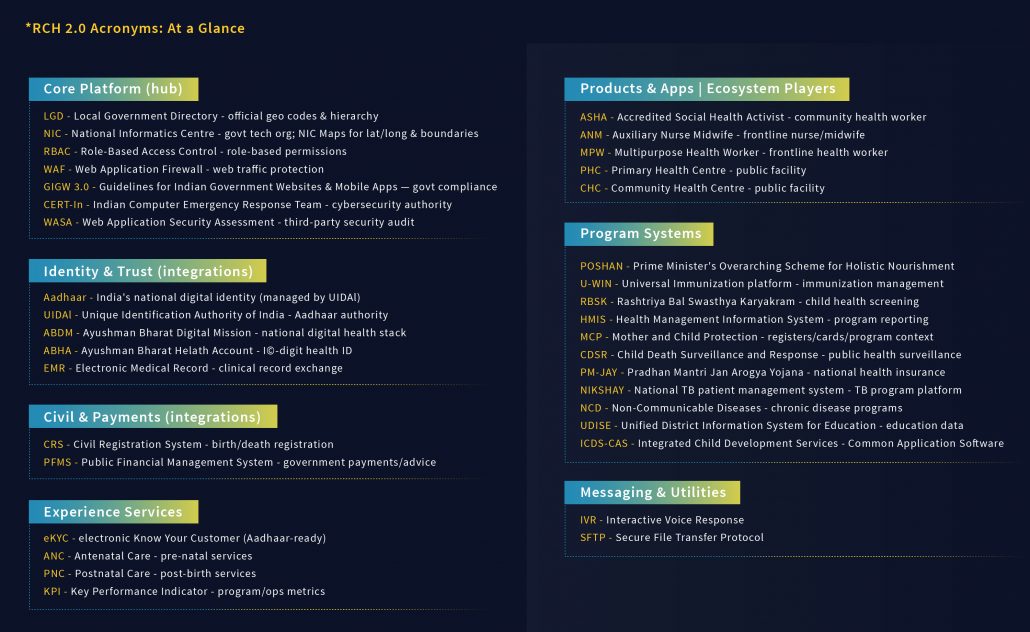
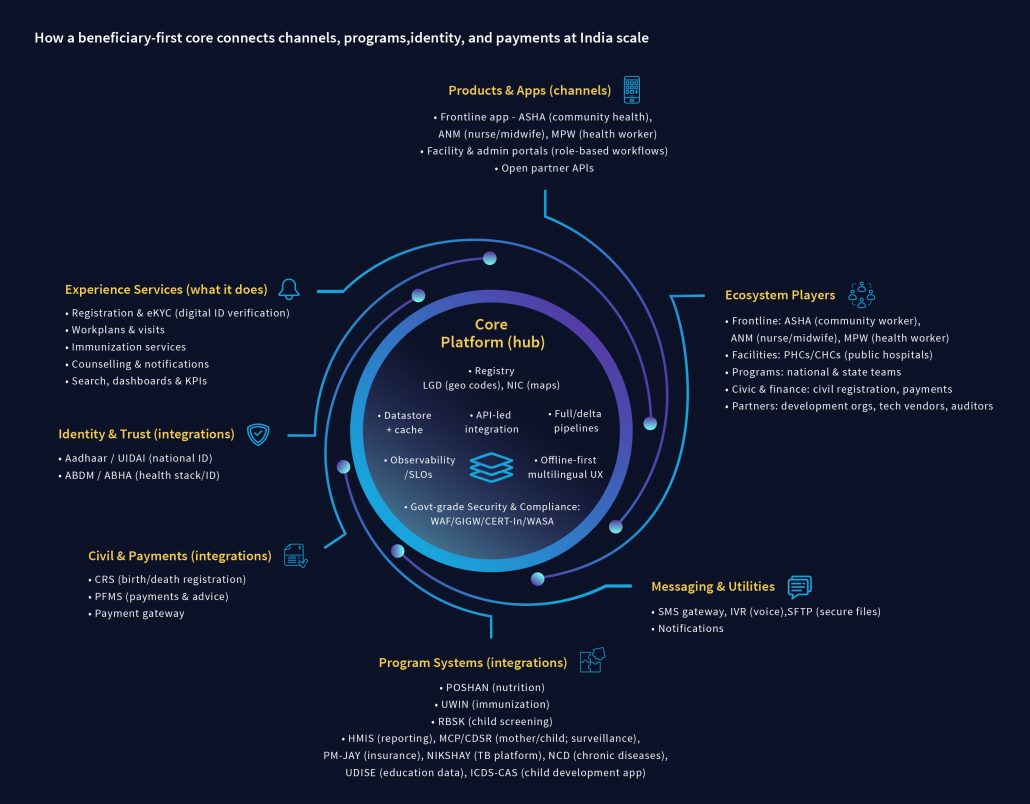
- Mobile-first frontline experience: Delivered web and mobile apps with role-based workflows for Accredited Social Health Activist (ASHA), Auxiliary Nurse Midwife (ANM), and Multipurpose Health Worker (MPW) so services work reliably in low-connectivity areas.
- Single national registry and beneficiary-first UX: Implemented a unified beneficiary registry and identity linkage to reduce duplicates and provide a consistent view of mothers and children.
- Interoperability at ecosystem scale: Integrated with Aadhaar / Unique Identification Authority of India (UIDAI), Ayushman Bharat Digital Mission (ABDM), Ayushman Bharat Health Account (ABHA), POSHAN (nutrition), U-WIN (Universal Immunization), Public Financial Management System (PFMS), Civil Registration System (CRS), and planned links to Rashtriya Bal Swasthya Karyakram (RBSK).
- Accurate geographies and governance: Aligned Local Government Directory (LGD) hierarchies and leveraged National Informatics Centre (NIC) map services for state-level precision.
This directly addresses national-scale delivery, fragmented legacy data, and ecosystem interoperability needs.
Also Check: Digital Integration Consulting Solutions
Data Engineering and Modernization
Built a secure, auditable data foundation.
- State-to-national migration to a single schema: Consolidated RCH 1.0 variants into one beneficiary-first schema across pilot states to improve traceability and reduce duplicates.
- Robust ingestion and operational pipelines: Implemented governed pipelines for full and incremental loads, including sandboxed data-cleaning for de-duplication and LGD mapping.
- Hosted on hardened government infrastructure: Operated within a Government Data Center (GDC) / certified environment to meet locality and data residency requirements.
- Data quality and lineage: Applied enrichment, de-duplication, and lineage tracking to provide auditable records for reporting and donor accountability.
This resolves legacy data fragmentation, ensures auditability, and underpins large-scale rollouts.
Learn More: Data Engineering and Data Modernization
Quality Engineering
Assured performance and reliability for mission-critical use.
- Automation-led test strategy: Delivered automation coverage targeting ~90% functional coverage, keeping defect leakage under 1% during release cycles.
- Performance and scale validation: Certified platform performance for ~5,000 concurrent users and ~300 transactions per second using realistic load profiles.
- Incremental validation and sandbox testing: Staged testbeds were used for data migration and cutover rehearsals to minimize production risk.
This eliminates peak-time scalability risk, reduces downtime during cutover, and ensures adoption confidence.
Must Check: Quality Engineering Services
Security and Compliance
Anchored to government standards and continuous monitoring.
- Government-grade assurance: Completed Web Application Security Assessments (WASA), adhered to Guidelines for Indian Government Websites and Mobile Apps (GIGW 3.0), and engaged CERT-IN (Indian Computer Emergency Response Team) processes as required.
- Runtime protection and monitoring: Deployed Web Application Firewall (WAF), centralized logging, and continuous security monitoring to protect sensitive PII/ SPI.
- Privacy and consent controls: Built consent frameworks and role-based access to meet regulatory and donor requirements for sensitive health data.
This addresses trust, privacy, compliance obligations, and donor reporting needs.
Recommended Explore: Application Security Services
Operational Readiness and Adoption
Handover, training, and runbooks for repeatable operations.
- Field enablement and training: Delivered role-based training, localized documentation, and offline runbooks for frontline workers and facility staff.
- Cutover rehearsals and hyper care: Conducted staged rehearsals, rollback planning, and post-go-live hyper care to ensure a smooth state-by-state rollout.
- Governance and handover: Transferred runbooks, dashboards, and operational ownership to client teams and SREs for long-term sustainability.
This ensures field usability, sustained operations, and predictable scale-up across states.
RCH 2.0 Ecosystem
Business Benefits
The modernized RCH platform delivered measurable program, operational, and data-quality gains at a national scale, strengthening frontline delivery, improving targeting, and enabling accountable outcomes for beneficiaries and funders.

Nationwide reach

Direct beneficiary impact
Seamless interoperability with government stacks

Proven performance at scale

Clean, trusted data

Higher field productivity and coverage

Improved coverage and user self-service

Government-grade security and compliance
Conclusion
Modernizing the RCH platform delivered a secure, beneficiary-first foundation that restores operational continuity and enables reliable, state-by-state scale.
By removing legacy fragmentation, improving data trust, and equipping frontline workers with offline, role-based tools, the program established a repeatable, auditable playbook for routine services and emergency surges.
With joint governance and operational handover to client teams, the platform now positions the program to accelerate coverage, tighten targeting, and demonstrate accountable impact to partners and funders.