

Contact us
  • From Manual to Machine- Transforming Claims Using Artificial Intelligence

Reimagining Claims for the AI-Driven Future

Claims are the insurer’s “moment of truth.” In 2025, the frontier shifted from simple digitization to intelligent, human-guided automation. This paper explores how generative and agentic AI are transforming the entire claims journey from intake and triage to fraud detection, litigation, payment, and subrogation. As AI in claims management gains momentum, insurers are rethinking traditional workflows and embracing Intelligent Claims Automation as a foundation for future-ready operations.

Key technologies include natural language processing (NLP) and document intelligence for fast, accurate First Notice of Loss (FNOL); computer vision and predictive models for one-touch decisions; and graph analytics for proactive fraud detection.

We also describe operating models that integrate AI into core platforms through dynamic workflows, role-based dashboards, and human-in-the-loop override paths to balance automation with informed human judgment. These models serve as the backbone of modern Intelligent Claims Automation, enabling scalable and compliant adoption of AI-led capabilities.

Why Claims Are Ground Zero for AI Transformation

The true test of any insurance experience, whether personal or commercial, comes at the time of a claim. 

The speed and quality of claim settlement depend on several factors: complexity, documentation accuracy, involvement of external parties, and the expertise of adjudicators. Traditionally, this process relied heavily on human effort. While machines now handle many repetitive tasks, human oversight remains critical to provide context and ensure fair decisions.

In 2025, insurers are no longer merely digitizing claims. They are reimagining the journey through AI in insurance claims, combining predictive analytics, automation, and human expertise to create a more responsive, intelligent, and customer-centric model. 

This paper explores how generative and agentic AI in claims management are transforming every stage of claims handling and reshaping the future of insurance operations. As insurers shift toward more intelligent and proactive claims processes, the journey itself is being re-engineered to deliver faster decisions, higher accuracy, and a better customer experience. The sections that follow break down how these capabilities are creating measurable impact across each step of the claims lifecycle.

How AI Transforms Claims Management Lifecycle

With the traditional claims model evolving quickly, insurers are now applying AI at each point of interaction, whether capturing the first notice of loss, triaging cases, detecting fraud, or supporting adjudication. The next sections outline how these innovations translate into real operational and customer value.

Intelligent Claim Intake

The claims journey begins with the first notification of loss, submitted through emails, web forms, or mobile apps.

AI-driven systems powered by NLP automatically extract essential details such as the date, time, and cause of loss. This structured data is then used to create claim records directly within the insurer’s system, reducing manual intervention.

For unstructured data such as images and videos, computer vision tools like Convolutional Neural Networks (CNNs) and Vision Transformers (ViTs) analyze content to extract critical information.

  • Automation at Scale: Microsoft Azure Logic apps and Document Intelligence streamline email handling and structured form processing.
  • Dynamic Engagement: Chatbots and virtual assistants, enhanced with sentiment analysis, assist claimants and prioritize urgent cases.
  • Agentic AI Follow-up: These systems identify missing information, summarize gaps, and automatically notify claimants—reducing delays and improving responsiveness.

Agentic AI also supports multi-party coordination, enabling seamless communication among claimants, adjusters, repair shops, and third-party experts.

Examples include:

A leading global insurer modernized its Commercial Auto First Notice of Loss (FNOL) process by integrating telematics, photos, and detailed incident data through a mobile-first interface. The new solution streamlines the entire reporting journey, enhancing speed, accuracy, and customer experience.

Smart Triaging and Adjusting

 AI-driven triage uses predictive analytics to assess claim outcomes and costs, often before a human ever reviews the case. This “one-touch claim” model reduces resolution times from days to minutes, allowing adjusters to focus on high-value, complex cases.

Claims are automatically categorized by severity, complexity, and urgency. AI then verifies coverage limits, orchestrates workflows, and either processes claims straight through or routes them to the appropriate teams, adjusters, investigative units, or repair shops.

Dynamic workflow engines adapt to each insurer’s needs, responding to data, business rules, and events in real time.

Examples include:

  • A leading U.S. insurer uses computer vision technology to generate instant repair estimates. Its intelligent models toggle seamlessly between automated and human reviews based on claim complexity.
  • Another global insurer leverages an advanced analytics-driven tool to triage commercial property claims efficiently.

Fraud Sentinel

Fraudulent claims cost insurers billions of dollars annually, driving up premiums for honest policyholders. Reducing fraud is essential to maintaining customer trust and controlling costs.

Modern AI tools allow insurers to detect fraudulent and exaggerated claims in real time. Historical claims data combined with third-party sources help flag anomalies during the claims process.

Using NLP, machine learning, and network analysis, AI in claims management systems can:

  • Identify suspicious behavioral patterns.
  • Detect deep-fake images or altered documents.
  • Uncover hidden relationships among claimants or third parties.

When human expertise is needed, the system routes flagged cases to a special investigative unit. Advanced techniques like ensemble modeling and copula regression now deliver unprecedented accuracy in fraud detection. Examples include:

  • A global insurer uses AI to identify fraud-related keywords in commercial claims.
  • Another leading insurer applies social network analysis to uncover organized fraud rings.

Litigation Management

 AI transforms litigation management by predicting claim escalation risks and estimating potential settlement values. It also identifies subrogation opportunities, pinpointing third parties who may share liability.

Key benefits include:

  • Rapid extraction of facts from large document sets.
  • Identification of relevant case laws to support decision-making.
  • Recommendations for external attorneys with proven expertise in similar cases.

Explainable AI (XAI) builds trust by providing transparent reasoning behind litigation-related decisions, ensuring compliance with regulations.

Agentic AI continuously monitors litigation progress, detects delays or compliance gaps, and suggests corrective actions. It can also autonomously update clients and legal teams through automated correspondence, reducing administrative burden.

Claim Payment

 AI-driven models are redefining claim settlement by delivering faster, more transparent, and explainable outcomes. By leveraging historical and real-time data, insurers can streamline payments to policyholders and vendors through digital gateways, guided by predefined thresholds. AI can also factor in litigation strategies to accelerate settlements, while maintaining compliance with privacy regulations such as PCI and GDPR, ensuring customer identities remain protected.

Continuous training and auditing of AI models are critical to prevent discrepancies, such as underpayments or overpayments, and to maintain accuracy across diverse payment types.

Examples include:

  • An insurer that achieved record-breaking claim settlement times—processing simple cases in just seconds.
  • Another provider that resolves straightforward travel and auto claims within minutes, enhancing customer satisfaction and operational efficiency.

Several technology partners are enabling this shift. For instance, solutions offered by organizations like LTIMindtree provide seamless integration with both legacy and modern claims platforms, along with role-based dashboards to track claim status, exceptions, and pending actions, all in a single view.

Subrogation

Traditionally, recoveries were pursued only after claim settlement, making the process reactive and labor-intensive. With AI, insurers can begin recovery efforts as early as the First Notice of Loss (FNOL) stage. By correlating large volumes of structured and unstructured data, AI can identify the responsible party, analyze state-specific laws, and even suggest law firms experienced in similar cases.

This proactive, data-driven approach speeds up settlements, minimizes manual intervention, and improves recovery rates.

Examples include:

  • An insurer leveraging AI-driven automation to streamline claim reviews and speed up settlements.
  • By applying intelligent modeling, another insurer unlocked four times more recoveries, all without added time or expense.

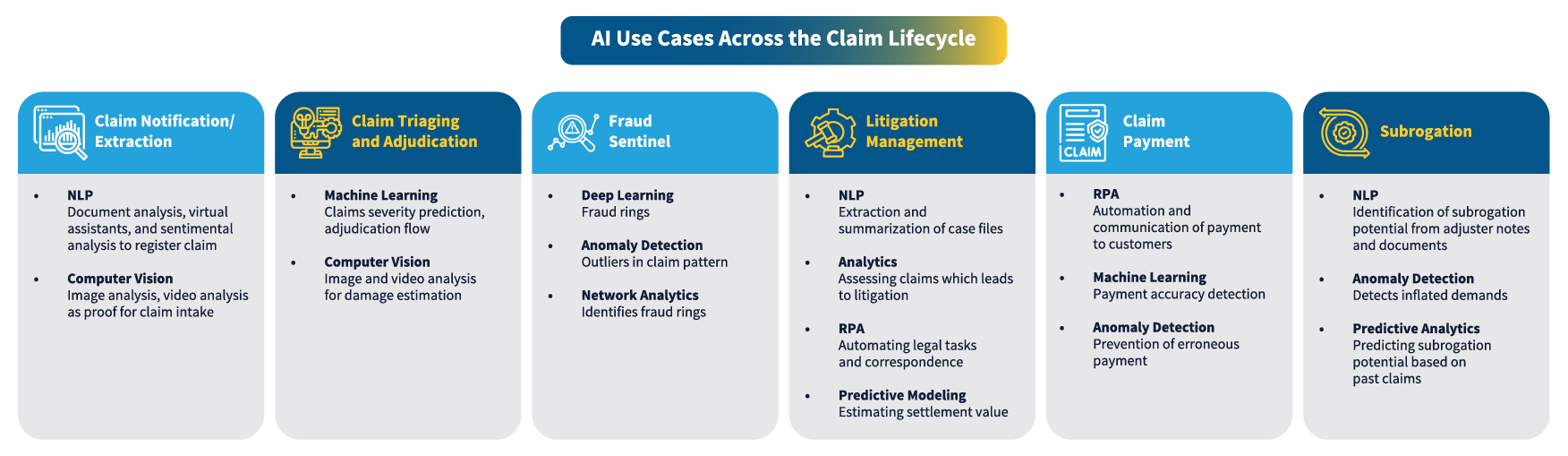
Figure 1 collates all the AI techniques used in the above-mentioned claims processes.

Figure 1: AI techniques used across the insurance claims value chain

The Way Ahead

AI is no longer optional; it is a strategic imperative for insurance claims, shaping speed, accuracy, and customer trust. From automated payments to proactive recoveries, its influence spans the entire claims lifecycle, but success depends on balancing automation with human oversight.

For insurers navigating this transformation, several lessons emerge: first, start small with targeted pilots to learn fast while limiting risks. Second, build modular systems that integrate seamlessly with both legacy and modern platforms—this prevents costly rework later. Third, invest in post-quantum and AI-ready security to safeguard sensitive data before vulnerabilities emerge. Finally, embrace partnerships with experienced technology providers. Organizations like LTIMindtree demonstrate how combining domain expertise with adaptive AI solutions can accelerate modernization, deliver measurable outcomes, and maintain operational resilience.

The key takeaway for leaders: AI adoption in claims is about creating an intelligence-driven claims ecosystem. Insurers who fail to act decisively risk slower settlements, missed recoveries, and eroded trust. Those who act thoughtfully, integrating AI with human expertise and robust processes, will set the benchmark for efficiency, transparency, and customer-centricity in the next AI-driven era of insurance.

Conclusion

There is a significant transformative opportunity for manufacturers to enhance the customer experience and create an immersive brand experience by adopting the metaverse in their automotive sales and marketing efforts. Although initially there are challenges, such as high investment costs, consumer adoption, and resistance to change, leading automobile manufacturers have already shown the way for others by overcoming these challenges in adopting the metaverse into their operations.

By leveraging various aspects of the metaverse, the industry is gradually shifting towards a hybrid model that offers both traditional and digital experiences. In the future, 10-15 years from now, as technology continues to advance, stakeholders will become increasingly more accepting of change. With an infrastructure boost, the industry will shift entirely to digital space, as numerous benefits are attached to a successful transition. For more information, write to us at mfg.communications@ltimindtree.com.

References

  1. Aviva: Rewiring the insurance claims journey with AI, McKinsey & Company:
    https://www.mckinsey.com/capabilities/mckinsey-digital/how-we-help-clients/rewired-in-action/aviva-rewiring-the-insurance-claims-journey-with-ai
  2. How technology, including AI, gives claims investigators an edge, Alice Ratcliffe, Zurich, September 23, 2024:
    https://www.zurich.com/media/magazine/2024/how-technology-including-ai-gives-claims-investigators-an-edge
  3. Allstate has been making significant strides in using AI to improve its claims communication process, February 12, 2025:
    https://entrelligence.com/allstate-has-been-making-significant-strides-in-using-ai-to-improve-its-claims-communication-process/
  4. Next-generation predictive modeling Delivering enriched claims experiences:
    https://business.libertymutual.com/wp-content/uploads/2022/08/61-5381_NextGen_PredictiveModeling.pdf

Author Bio

Subasree Sampath is an Associate Principal in insurance consulting with over 21 years of experience across Property & Casualty insurance and information technology. She has deep domain expertise and has led multiple transformation initiatives. She holds a master’s degree in Life Sciences from the University of Madras, Chennai, India, and is a Fellow of the Insurance Institute of India as well as an Associate of Personal Insurance from The Institutes, USA.


Subasree Sampath, Associate Principal – Business Analysis – INS BA & Product

Mayur Parakh is an Associate Principal in insurance consulting with 18 years of experience in Property & Casualty insurance and IT. He specializes in claims, underwriting, and policy administration systems, with hands-on experience in implementing and optimizing core insurance platforms. He has successfully led digital transformation and product implementation programs across multiple geographies and holds a master’s degree in business administration from Pune University.


Mayur Parakh, Associate Principal – Business Analysis – INS BA & Product

Common Page CSS / JS

Contact Us