


Home › Industries › Energy and Utilities › Digital Twin Enablement & Surface Data Hub for Smarter Oilfield O...
Client
The client is a leading American multinational energy corporation with a global presence across the oil and gas value chain. Vertically integrated, it operates across upstream exploration, midstream transportation, and downstream refining, marketing, and power generation. The company also has a strong foothold in chemicals manufacturing and energy solutions.
As part of its strategic push toward operational excellence and sustainability, the client sought to modernize its oilfield operations through intelligent data platforms and real-time asset visibility. The goal was to leverage predictive maintenance and digital twin technologies to minimize equipment downtime, enhance reliability, and drive data-informed decision-making across their production and surface operations.
Market Trends
The global liquefied natural gas (LNG) market is undergoing a rapid transformation, driven by rising demand for cleaner energy sources, increased investments in infrastructure, and a strong push for operational efficiency. As countries seek to reduce carbon emissions and transition away from coal and oil, LNG has emerged as a strategic fuel for both domestic consumption and international export. In Africa, large-scale LNG projects are reshaping regional energy landscapes, attracting billions in investment and fostering economic growth. Companies are prioritizing digitalization, data-driven decision-making, and compliance with international standards to remain competitive and future-ready in a dynamic market environment.
Need for Change
Oil and gas operations are becoming increasingly complex, with expanding asset networks, legacy systems, and disparate data sources creating significant challenges in maintaining operational efficiency. Surface operations, in particular, generate massive volumes of equipment, maintenance, and production data, often trapped in silos and inconsistent formats. This fragmentation limited collaboration, slowed analytics, and raised compliance risks across critical workflows.
To overcome these constraints, the client aimed to establish a unified Surface Data Platform that could centralize operational datasets, enable predictive maintenance, and support Digital Twin models. The initiative aimed to standardize data, improve reliability, and empower field teams with real-time, actionable insights. This laid a strong foundation for oil and gas data modernization.
Business Challenges
Despite a clear vision for modernization, the client’s data environment remained fragmented and operationally rigid. The absence of a centralized Surface Data Hub meant that vital operational data, ranging from equipment and tag information to work orders, was scattered across disconnected systems. This fragmentation weakened collaboration, slowed decision-making, and limited the effectiveness of analytics-driven initiatives. Key pain points included:
Key objectives
-

Establish centralized governance and monitoring for the entire agent lifecycle and cost tracking
-

Enable dynamic orchestration of agents across real-time and static data sources
-

Integrate seamlessly with internal systems and support open-source frameworks
-

Implement robust AI testing and evaluation mechanisms
-

Reduce time-to-market through reusable components and streamlined deployment
-

Ensure secure access and global compliance through role-based access control (RBAC)
LTIMindtree Solution
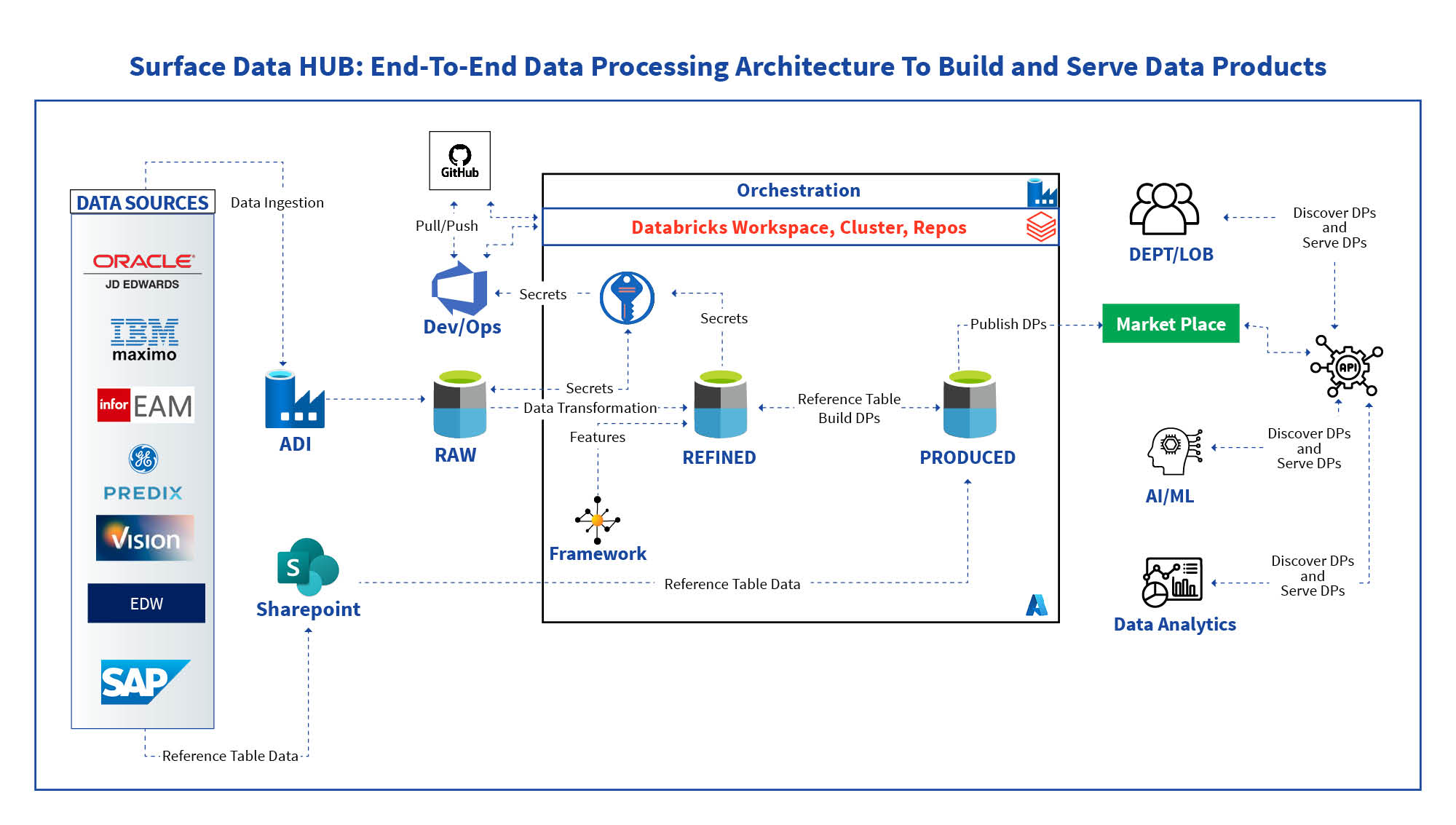
To overcome data fragmentation and operational silos, LTIMindtree built a scalable, cloud-native Surface Data Hub. It is a unified platform, enabling seamless access to equipment, tag, and work order data across business units. This foundation powered real-time analytics, predictive maintenance, and Digital Twin initiatives, helping the client achieve efficiency, reliability, and innovation across the energy value chain. Key highlights of the solution included:
Layered Data Architecture with Databricks
Using Databricks, LTIMindtree established a robust three-tiered pipeline:
- Bronze Layer (Raw): Consolidated daily data from legacy and operational systems.
- Silver Layer (Refined): Cleaned and standardized data into a consistent model hosted on Azure Data Lake.
- Gold Layer (Produced): Aggregated refined datasets into unified enterprise-grade data products for analytics and operations.
More than 40 data products were created, such as FacilityView (overview of all facilities), TagDirectory (standardized engineering tags), and WorkOrderSummary (centralized maintenance tracking), enabling a single, trusted view of assets, activities, and performance metrics.
Automation and Framework Development
To overcome inconsistencies caused by manual processes and siloed data handling, Azure Data Factory automated the entire data flow, from ingestion to transformation and publishing, ensuring scalability and accuracy. Complementing this, a custom, reusable framework standardized the processing of logic across business units, eliminating redundancy and maintaining consistency. It also included built-in functions for data quality validation, schema evolution, and audit tracking, reducing manual intervention and accelerating delivery across the enterprise.
Business Enablement and Strategic Alignment
Building on standardized architecture and automation, teams gained access to reliable, unified data across functions. This trusted foundation enabled real-time analytics, predictive maintenance, and Digital Twin simulations, turning data into actionable insights. It also strengthened compliance, fostered collaboration, and empowered the enterprise to make confident, data-driven decisions at scale.
Data Product Assurance
Extending this unified and governed approach, each data product was built with consistency, accessibility, and governance at its core. Standardized logic and structure maintained uniform data representation across business units, minimizing discrepancies and enabling smoother collaboration. These products integrated effortlessly with downstream analytics and reporting systems, making insights easier to generate and act upon. A robust governance and metadata framework further ensured transparency, compliance, and traceability, which established a trusted foundation for confident, enterprise-wide decision-making.
Tech Stack
| Backend Technologies | Azure SQL Server, Spark SQL, Share point |
| Cloud Resources | Azure Databricks, Azure Data Lake, Azure Storage account, Azure Data Factory |
| DevOps | CI/CD pipelines, Azure DevOps |
Business Benefits
The initiative accelerated the client’s oil and gas data modernization journey, transforming fragmented systems into a connected, intelligent data ecosystem. Through 30+ scalable data products and 40+ automated validation checks, the client operated with greater efficiency, transparency, and trust in its data. By enabling Digital Twin in oil and gas, the platform enhanced real-time visibility and predictive insights across operations.

Increased Operational Efficiency

Enabled Cross-BU Collaboration

Strengthened Governance and Compliance

Reduced Time and Costs

Ensured Enterprise-Wide Consistency

Maximized Automation and Self-Service

Maintained Data Security and Compliance

Delivered Federated, On-Demand Access
Conclusion
By modernizing operational data through the Surface Data Hub, the client built a trusted foundation for predictive intelligence and agility. The initiative strengthened collaboration, ensured compliance, and advanced oil and gas data modernization efforts.
Building on this success, the next phase extends the Surface Data Hub to include maintenance inspection data products, deepening insights into asset health, inspection schedules, and compliance tracking. With enhanced monitoring, governance, and scalable frameworks for rapid onboarding of new data products, the client is well-positioned to scale predictive maintenance and accelerate Digital Twin adoption enterprise wide.
Ready to transform your operational data into actionable insights?
Discover how LTIMindtree empowers energy enterprises to unlock predictive maintenance, enable Digital Twin capabilities, and drive cross-functional efficiency across upstream and downstream operations.
Find us at eugene.comms@ltimindtree.com to get a tailored solution for your field operations.
