



Overview
In the oil and gas industry, accurately estimating well rates is critical for
optimizing production and managing performance, but it remains a persistent challenge across many
subsurface operations. The client faced challenges in well rate estimation for wells
lacking multiphase meters. They partnered with LTIMindtree for an innovative, AI-powered solution to estimate real-time production rates.
LTIMindtree’s Solution
LTIMindtree developed a well rate estimation solution using ML.NET to provide real-time estimates for wells lacking multiphase flow meters. Key aspects of the solution included:
ML-Based Rate Estimation Engine
Deployed machine learning models that generated real-time well rate estimates for wells lacking Multiphase Flow Meter (MFPM) instrumentation or those operated by third parties.
Automated Model Lifecycle Management
Implemented automated pipelines for continuous training, validation, and updating of ML models to ensure sustained accuracy and adaptability.
High-Frequency Output and Accuracy Monitoring
Enabled high-frequency rate generation with integrated accuracy statistics to support operational decision-making and performance tracking.
Alternative Production Evaluation Methodology
Provided a reliable substitute for traditional production evaluation techniques, enhancing visibility into well performance across diverse asset types.
Business Challenges
Despite a clear vision for modernization, the client’s data environment remained fragmented and operationally rigid. The absence of a centralized Surface Data Hub meant that vital operational data, ranging from equipment and tag information to work orders, was scattered across disconnected systems. This fragmentation weakened collaboration, slowed decision-making, and limited the effectiveness of analytics-driven initiatives.
Key pain points included:

Disparate Systems
Poor Data Quality
High Integration Costs
Security and Compliance Risks
Limited Scalability
Governance and Empowerment Deficiency
Tech Stack and Architecture
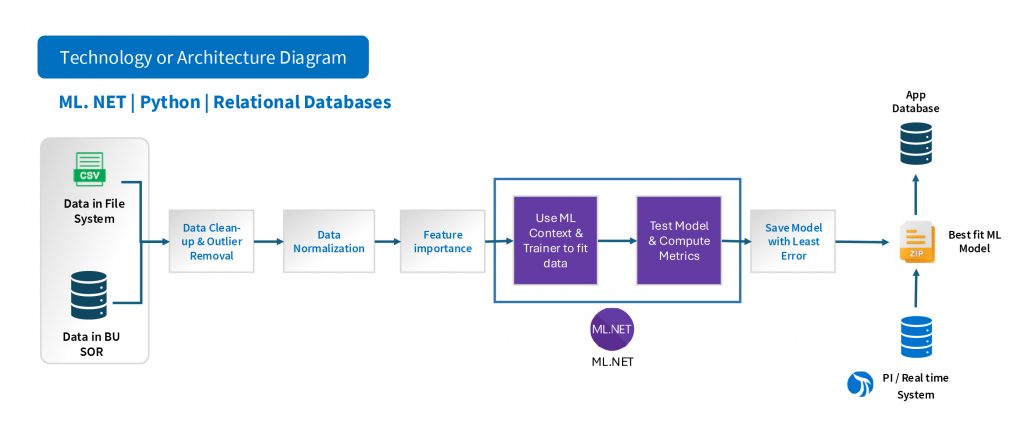
Benefits
Real-Time Visibility
Transparent Analytics
Alternative Evaluation Method
Conclusion
LTIMindtree’s well rate estimation solution, built using ML.NET, gave the client a smart, reliable way to monitor production in wells without multiphase flow meters—many of which were operated by third parties. By automating the full lifecycle of the machine learning models and enabling high-frequency, accurate rate estimates, the solution offered real-time visibility and analytics that traditional methods couldn’t provide. This solution highlights illustrates how energy companies can use AI and machine learning to unlock greater agility, precision, and scalability in production monitoring across complex upstream portfolios.



Discover how AI-based solutions can transform oil and gas production operations and optimize workflows. Reach out to our experts today.
Contact eugene.comms@ltimindtree.com to know more.
