



Explainable AI (XAI): Unlocking Trust and Innovation in the Life Sciences Industry
Artificial Intelligence (AI) is changing the life sciences, from drug discovery to patient care. However, as AI systems become more complex, they are harder to understand, raising trust and safety concerns. In healthcare, clarity is vital; professionals and regulators must know how AI makes recommendations. As AI use increases in clinical trials, diagnostics, and personalized medicine, explainability is crucial to avoid regulatory, ethical, and reputational risks. Explainable AI (XAI) addresses these issues by making decisions transparent, and is essential for responsible innovation in life sciences.
The current state: Why XAI matters
AI is advancing rapidly in life sciences, transforming disease prediction, clinical trials, and drug discovery. However, increased adoption brings transparency concerns. Recently, a pharmaceutical company’s AI-powered cancer vaccine faced FDA scrutiny over an algorithm’s safety and reliability. To ensure consistency and minimize risk, the FDA required the algorithm to remain unchanged during clinical trials.
Calls for transparency in AI healthcare are rising among patients and professionals. According to a European Patients’ Forum survey, 48% worry about safety risks from low-quality AI, and 45% are concerned about how these algorithms work.2 These findings highlight the need for explainable, trustworthy AI in healthcare decision-making.
Advances in XAI, such as counterfactual reasoning, SHapley Additive exPlanations (SHAP), and Local Interpretable Model-agnostic Explanations (LIME) are making AI more transparent. These tools help stakeholders assess and trust AI’s outputs. As AI becomes integral to life sciences, XAI is both a technical necessity and strategic advantage for organizations meeting regulatory standards.
Barriers to the adoption of XAI in life sciences
- Technical Complexity and Usability Barriers
- Complexity and technical barriers: XAI methods like SHAP and LIME provide valuable insights but remain highly technical and require expert knowledge, making them difficult for clinicians and non-specialist teams to interpret and apply effectively.
- Balancing accuracy and clinical usability: Integrating XAI into healthcare is difficult because clear, actionable explanations often reduce model accuracy, making it hard to combine interpretability with reliable performance for complex clinical decision-making.
- Lack of standards and regulatory clarity
- Lack of standardized benchmarks: There are no clear standards for judging how well AI explains itself in life sciences, making it tough for people to compare or share best practices.
- Evolving regulatory expectations: With agencies like the Food & Drug Administration (FDA) and European Medicines Agency (EMA) still ironing out XAI-related rules, companies often face confusion and delays when trying to comply.
- Resource and organizational constraints
- High costs: Setting up XAI can be expensive, needing extra tools, staff training, and careful checks. For organizations with tight budgets, these costs can be a real hurdle.
- Limited capacity in smaller organizations: Smaller companies often find it hard to use XAI because they may not have enough money or skilled personnel.
- Cultural resistance and education gaps
- Resistance to change: Some stakeholders are unsure about XAI, seeing it as complicated or unnecessary, which can make adoption slower.
- Limited awareness and training: Many clinicians and researchers lack training in XAI, making it hard for them to trust or understand AI results.
Solutions and recommendations: Implementing XAI in life sciences
- Explainability-driven model design
Organizations should prioritize explainability in AI design by selecting interpretable models, such as decision trees or interpretable neural networks. Established XAI frameworks like SHAP, LIME, and IBM’s AI Explainability 360 offer insights to support clinicians and regulators in understanding AI decisions. For instance, SHAP clarified an AI-flagged high sepsis risk in ICU patients, helping facilitate timely interventions.Example:
Researchers used LIME to find that a COVID-19 X-ray model was influenced by irrelevant areas outside the lungs. By adding U-Net segmentation to mask non-lung regions, they improved accuracy to 95.5%. - Stakeholder collaboration and education
Effective XAI in life sciences requires collaboration between AI developers and domain experts to ensure explanations are sound and useful. For instance, in Alzheimer’s detection, SHAP and LIME help clinicians interpret predictions and identify biomarkers. Education is also vital; hospitals hosting XAI workshops see increased trust, adoption, and better patient outcomes through improved understanding of AI-supported decisions.Example:
A systematic review of AI models for Alzheimer’s detection highlights the value of XAI in making results understandable to clinicians. Tools like LIME and SHAP clarify model predictions, helping professionals identify biomarkers and match AI outputs with clinical knowledge. XAI promotes transparency and reliability in patient care. - Prioritize regulatory compliance
Organizations must follow changing regulations for responsible AI use in healthcare. Agencies like the FDA, EMA, and Joint Commission stress transparency and accountability. Companies should clearly document XAI practices and be prepared to explain their models during audits and reviews.Example:
FDA’s Good Machine Learning Practice (GMLP) and the EU’s AI Act mandate clear documentation of AI decision processes in medical devices. Transparency is crucial for compliance and trust among clinicians, patients, and regulators. - Monitor and update models
AI models need ongoing monitoring to sustain performance and explainability. Regular retraining and updated explanations are vital as new data emerges, keeping AI accurate and trustworthy for stakeholders.Example:
Digital Diagnostics, the creator of FDA-cleared LumineticsCore® AI, prioritizes safety and reliability in healthcare AI. The team regularly updates its diagnostic model based on physician inputs and new clinical data to maintain accuracy and transparency. By following these practices, they meet regulatory standards and build trust with medical professionals and patients, demonstrating AI’s value as a responsible healthcare partner.
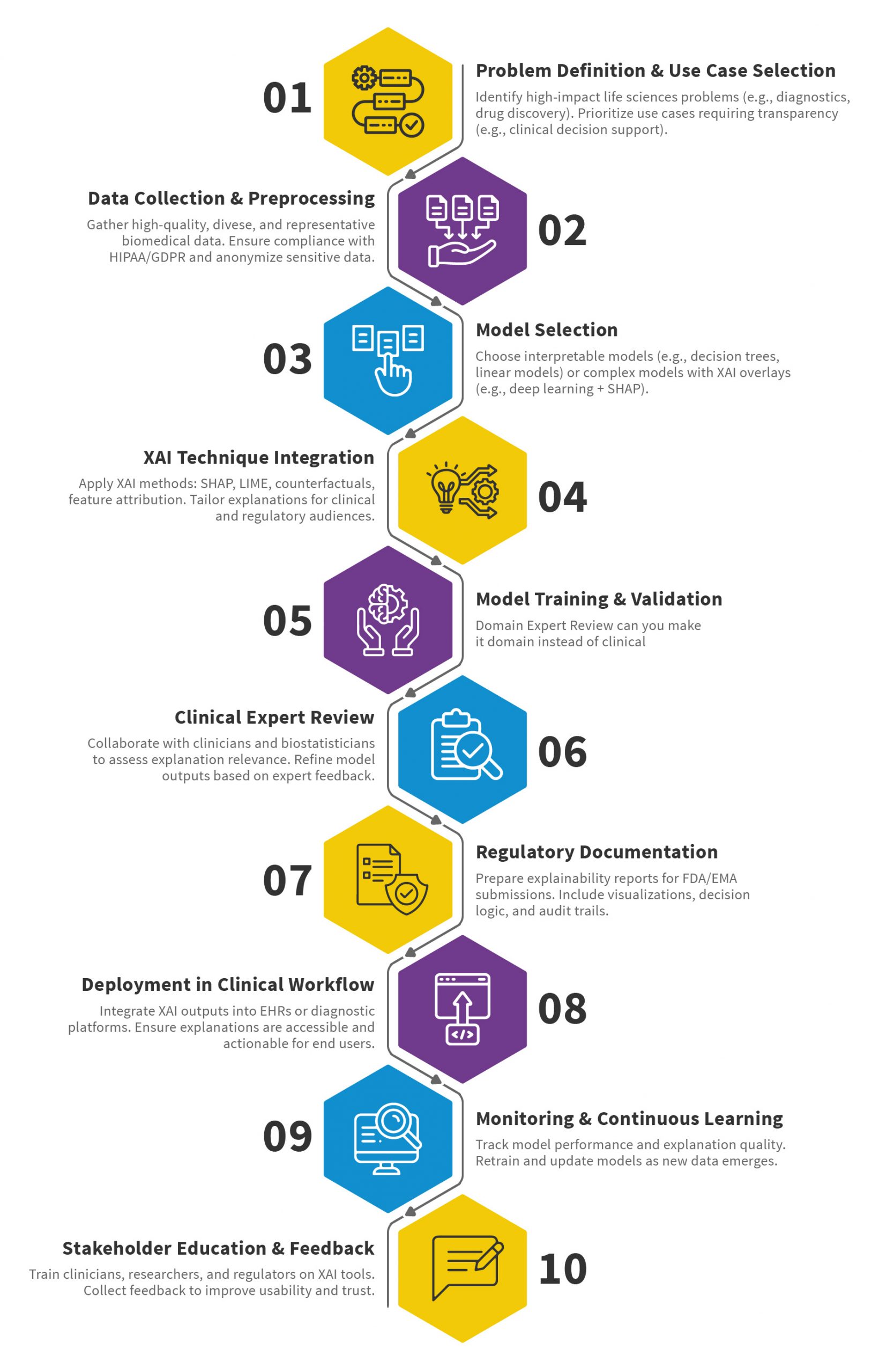
Integrating XAI in the AI development lifecycle in life sciences
Conclusion
XAI is transforming the life sciences landscape by making complex algorithms more accessible and understandable to humans. As AI becomes deeply embedded in drug development, diagnostics, and patient care, transparency is essential. Organizations that prioritize XAI meet regulatory requirements and foster trust among clinicians, patients, and partners. The future of life sciences will be shaped by responsible AI adoption, where explainability drives innovation and safeguards patient outcomes. The key message: embracing XAI today is crucial to unlocking AI’s full potential while ensuring ethical, transparent, and compliant practices.
References
- Personalized cancer vaccine design using AI-powered technologies,
https://pmc.ncbi.nlm.nih.gov/articles/PMC11581883/ - Assessing AI Awareness and Perceptions among Patient Organisations,
https://www.eu-patient.eu/globalassets/epf-ai-survey-for-patient-organizations_results-2023.pdf - Prediction of sepsis mortality in ICU patients using machine learning methods,
https://pmc.ncbi.nlm.nih.gov/articles/PMC11328468/ - Deep Learning Algorithms with LIME and Similarity Distance Analysis on COVID-19 Chest X-ray Dataset,
https://pmc.ncbi.nlm.nih.gov/articles/PMC10001452/ - Interpreting artificial intelligence models: a systematic review on the application of LIME and SHAP in Alzheimer’s disease detection,
https://pmc.ncbi.nlm.nih.gov/articles/PMC10997568/ - Digital Diagnostics – The First Autonomous AI Healthcare Diagnostic,
https://d3.harvard.edu/platform-digit/submission/digital-diagnostics-the-first-autonomous-ai-healthcare-diagnostic/
Blogger's Profile

Pratik Shah
Associate Director – Program & Project Management
Pratik Shah has 17+ years of IT experience, with over a decade dedicated to the life sciences and healthcare sectors. His keen ability and sharp insights enable him to effectively understand client needs and create customized solutions. Pratik has played a crucial role in presales and sales enablement, leveraging his extensive healthcare and life sciences IT knowledge to drive innovation and improve patient outcomes.
More from Pratik Shah
In today’s healthcare landscape, patient-centric care is more important than ever. As patients…
Latest Blogs
Introduction There is a lot of noise around Agentic AI right now. Every headline seems to…
Traditionally operations used to be about keeping the lights on. Today, it is about enabling…
Generative AI (Gen AI) is driving a monumental transformation in the automotive manufacturing…
Organizations are seeking ways to modernize data pipelines for better scalability, compliance,…
