



Home › Industries › Energy and Utilities › Smarter Wells, Faster Decisions: AI-Driven IPR Estimation at Scale
Overview
AI-driven reservoir fluid inflow performance relationship (IPR) estimation offers engineers a better understanding of decline in reservoir pressure, enabling them to identify optimal lift methods to boost production. In the case of unconventional wells—where reservoir pressure declines rapidly—traditional inflow performance models fall short. This challenge necessitated the development of an alternative IPR estimation approach powered by artificial intelligence.
Market Trends
The global liquefied natural gas (LNG) market is undergoing a rapid transformation, driven by rising demand for cleaner energy sources, increased investments in infrastructure, and a strong push for operational efficiency. As countries seek to reduce carbon emissions and transition away from coal and oil, LNG has emerged as a strategic fuel for both domestic consumption and international export. In Africa, large-scale LNG projects are reshaping regional energy landscapes, attracting billions in investment and fostering economic growth. Companies are prioritizing digitalization, data-driven decision-making, and compliance with international standards to remain competitive and future-ready in a dynamic market environment.
Need for Change
Oil and gas operations are becoming increasingly complex, with expanding asset networks, legacy systems, and disparate data sources creating significant challenges in maintaining operational efficiency. Surface operations, in particular, generate massive volumes of equipment, maintenance, and production data, often trapped in silos and inconsistent formats. This fragmentation limited collaboration, slowed analytics, and raised compliance risks across critical workflows.
To overcome these constraints, the client aimed to establish a unified Surface Data Platform that could centralize operational datasets, enable predictive maintenance, and support Digital Twin models. The initiative aimed to standardize data, improve reliability, and empower field teams with real-time, actionable insights. This laid a strong foundation for oil and gas data modernization.
LTIMindtree’s Solution
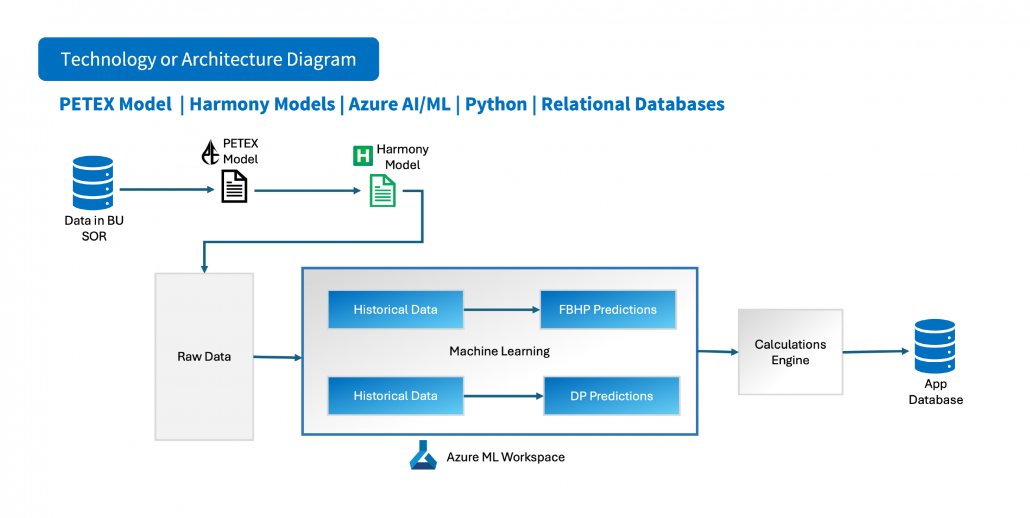
Using Azure-based AI/ML models, LTIMindtree enabled intelligent reservoir pressure estimation to support inflow performance relationship (IPR). Key aspects of the solution included:
AI-ML Model for Inflow Estimation
Developed an AI/ML model to forecast inflow performance for unconventional wells, enabling proactive production planning and optimization.
Physics-Informed Input Integration
Leveraged inputs derived from physics-based models to enhance the accuracy and reliability of predictions, ensuring alignment with subsurface dynamics.
Reservoir Pressure Estimation Module
Incorporated reservoir pressure estimation capabilities to support real-time decision-making and optimize well performance under varying operational conditions.
Tech Stack and Architecture
Benefits

Advanced Modelling
Optimized production with ML-Driven Predictions
Physics-Informed Input
Proactive Well Management
Conclusion
LTIMindtree’s Azure-based AI/ML solution transformed IPR estimation for the client by replacing manual, error-prone tasks with intelligent, predictive models. By combining physics-based inputs with machine learning, the solution delivered accurate reservoir pressure forecasts, real-time visibility into well performance, and more proactive well management. The result? Better production efficiency, lower operational overhead, and quicker, data-driven decisions across subsurface operations. By enabling scalable, data-led optimization, this solution is setting a new standard for how the energy industry approaches digital transformation in the field.




Discover how AI-based solutions can transform oil and gas production operations and optimize workflows. Reach out to our experts today.
Contact eugene.comms@ltimindtree.com to know more.
