
Overview
The fundamental operating model for IT services has remained largely unchanged over the last three decades that I’ve been in the industry. Yes, computing paradigms have evolved from monolithic mainframes to agile, cloud-native ecosystems. But the underlying workflows of application development and maintenance advanced only incrementally. Service delivery has long been orchestrated by humans, constrained by linear, people-dependent productivity models.
Today, the interplay of generative AI, agentic systems, and intelligent automation presents a watershed moment. We are now at the cusp of a drastic transformation, moving from linear improvements to breakaway productivity.
This is not about simply layering AI onto existing processes. Delivery reimagination in its true sense requires fundamental deconstruction and reconstruction of traditional workflows. It demands a shift from human-centric handoffs to autonomous orchestration and from mastering syntax to composing symphonies of technology. For leaders in Fortune 500 organizations, the question is no longer if AI will disrupt delivery, but how to harness this disruption to build a sustainable competitive advantage.
From Linear Delivery to Breakaway Productivity
The traditional IT delivery model, particularly in areas like application maintenance services (AMS), is characterized by a series of handoffs. A ticket arrives, an L1 team triages it, some basic automation is applied, and then it is escalated to L2 or L3 support. While effective for its time, this model is inherently linear; its capacity for improvement is finite and often plateaus after initial optimizations. Companies might squeeze out 20-30% efficiency over a five-year contract, but these gains are incremental, not transformative.
Similarly, application development has historically relied on the individual programmer’s ability to master a language, translate complex business logic into precise syntax, and manually write the code. This approach is labor-intensive and susceptible to human error. AI promises to overcome these linear constraints. Instead of incremental gains, we can now target breakaway productivity, a step-change improvement to the tune of 40-50% or more. This is achieved by redesigning workflows from the ground up, replacing human orchestration with autonomous systems wherever possible.
Imagine an AMS model where an army of AI agents acts as the front line. These agents can diagnose, deflect, and resolve a significant portion of incoming tickets without human intervention, creating a touchless workflow. The human-in-the-loop becomes an exception handler, a strategist focused on complex problem-solving rather than repetitive tasks. This is the essence of moving from a human-centric workforce to a “human++” model, augmented by AI.

The Foundation: Trusted Data and an Intelligent Delivery Layer
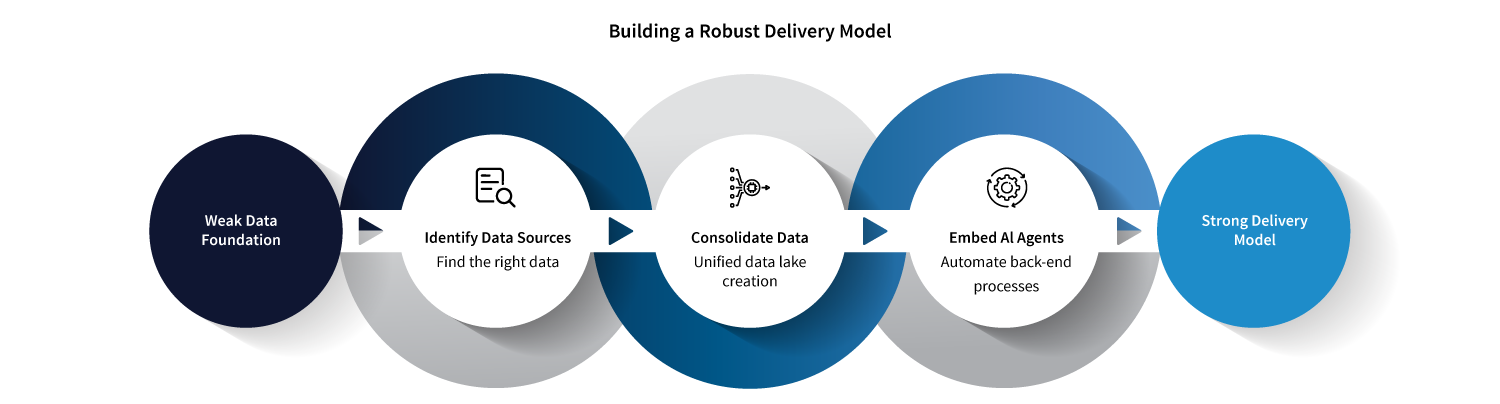
A reimagined delivery model cannot be built on a weak foundation. Success begins with trusted, high-quality data. In the rush to deploy AI, many organizations overlook the criticality of data hygiene, creating a “garbage in, garbage out” scenario where AI agents optimize for the wrong outcomes. Establishing a robust data strategy is the first-order constraint. This involves identifying the right sources of data, from financials and talent metrics to operational risks and deal pipelines, and consolidating them into a unified data lake.
With this foundation, an intelligent delivery layer can be constructed. Think of this as the central nervous system for IT delivery. This layer ingests data from siloed functions such as finance, talent acquisition, and project management, and transforms it into actionable insights. For decision makers, this means moving beyond static PowerPoint decks and Spreadsheet-driven business reviews. Instead of a wild goose chase to diagnose a drop in profit margins, a sales leader run a query using the intelligent layer and receive an immediate, data answer backed by data: “Your margin dropped for three reasons: a 15% increase in resource costs, a failure to meet the planned trainee mix, and an average deal closure EBIT of 15% against a target of 20%.”
The intelligent delivery layer provides the visibility and control needed to manage a complex, global delivery organization with precision. This layer does more than share insights; it powers autonomous operations. AI agents embedded within this layer can automate back-end processes, from order-to-cash and invoicing to employee onboarding, creating a touchless operational backbone. The result is efficiency along with predictive accuracy.
From Syntax to Symphony: Composing the Future of Development
The reimagination of delivery extends deep into the roots of software engineering. A developer’s role today is evolving into one that is more solution-oriented, rather than being merely a coder. The premium is no longer on mastering the syntax of a single programming language, but on understanding the broader technology landscape to achieve a business outcome.
This is the shift from “syntax to symphony.” The developer becomes a conductor, bringing together AI-generated code, pre-built components, API integrations, and cloud services to create a cohesive and functional application. Their value lies in architectural vision, strategic problem-solving, as well as the ability to connect the dots between disparate technologies. The tedious, hygiene-related aspects of coding are automated, freeing up human talent to focus on higher-order challenges, such as system design, user experience, and business logic innovation.
This paradigm shift will fundamentally change commercial models. The conversation with clients will move away from inputs like, “How many Java developers do you need?” to outcomes like, “How quickly can you build this system for me?” The mechanics of how the system is built will become a managed black box, and the value proposition will center on speed, quality, and business impact. This evolution naturally leads to outcome-based contracts, where partners are rewarded for the results they deliver, not the hours they bill.
The Power of a Common Core
The traditional approach of siloing delivery teams by industry vertical or technology stack is obsolete. A modern delivery organization requires a unified, AI-powered core that cuts across verticals and service lines. This common core is a standardized, reusable set of assets, methodologies, and AI agents that can be deployed across different clients and industries.
Building this core is a strategic imperative. It ensures that best practices and innovations are scaled across the entire organization, rather than remaining trapped in isolated pockets. This playbook must be supported by robust guardrails for security, compliance, and governance. As clients cede more operational control to AI-driven systems, they need assurance that the process is secure, transparent, and that they remain in control. The “human in the loop” is a critical governance function that ensures AI aligns with enterprise policies and ethical standards.
A tangible example of this reimagination in practice can be seen with an automotive parts company that transformed its audit process. The previously manual and time-consuming workflow was redesigned using AI, enabling audits to be conducted autonomously. This has accelerated the process, increased accuracy, and freed up employees for more work.
LTIMindtree is redefining project management with AI and automation, simplifying the project manager’s role and enhancing delivery excellence. Its unified platform integrates chatbots, analytics, and real-time alerts, enabling automated risk detection, contract tracking, and project health monitoring. With 20–40% lower cost of quality and 25–35% productivity gains, it ensures faster turnarounds, improved visibility, and client satisfaction.
A Winning Mantra for Fortune 500 Leaders
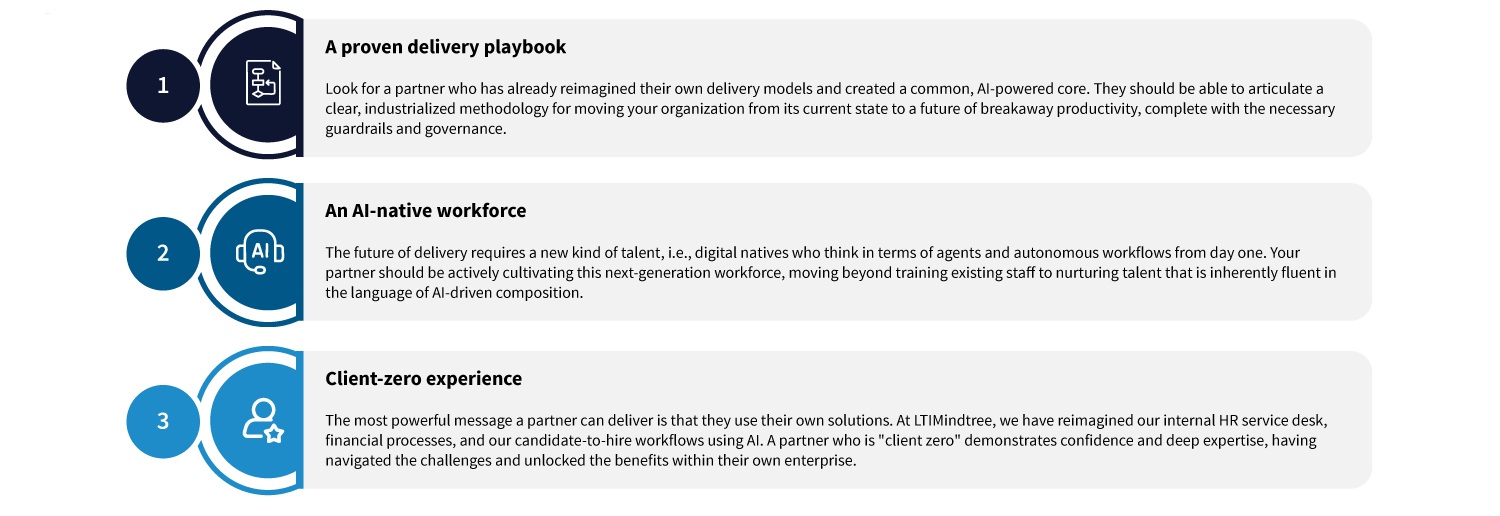
As you navigate this transformative landscape, selecting a technology partner is crucial. The market is flooded with “AI washing” and tactical claims about agent libraries or certified developers. These are table stakes, not differentiators. To truly succeed, you need a partner who has moved beyond the hype and operationalized a new vision for delivery.
Your winning mantra is to consider a partner who can demonstrate three key attributes:
No single approach is guaranteed, and progress rarely moves in straight lines. Thus, the path forward lies in a strategic blueprint that integrates trusted data, an intelligent delivery layer, and a common core built for the AI era. As leaders at this moment, are you prepared to let go of linear thinking and lean into ambiguity, i.e., into symphony over syntax, questions over answers? Ultimately, the true breakthrough may not be in the agents you buy, but in the reimagination of everyday workflows and the adoption of change. Customer expectations are sky high. IT players who move from experimentation to industrialization make all the difference. The onus is now on us to harness the massive wave of industrialization enabled by AI.