


Agentic AI Platform
Smart ecosystems drive change. Enterprises are adding layers of AI to demonstrate adoption. But the real story is about making AI work together with your people, processes, and systems to drive change. It’s about fueling change that actually sticks, change you can measure, change that matters. That’s where the BlueVerse agentic AI platform brings autonomy, alignment, and action into one evolving ecosystem.
The agentic AI platform represents the next stage of enterprise intelligence. This allows AI agents to collaborate with teams through everyday communication and project management tools, utilize data and technology to identify opportunities, assess risks, and make real-time decisions at all levels.
Through agentic AI platforms, companies can achieve governed autonomy. AI agents can independently execute complex, multi-step tasks, but they remain strictly aligned with business objectives through a centralized policy engine and immutable audit logs that track every action.
From self-optimizing supply chains to predictive service management, agentic AI transforms workflows. It unlocks a new operating model for enterprises that’s proactive by design. Instead of relying on human-triggered batch processes, the platform is built to continuously monitor data streams and trigger agent actions based on changing conditions.
Core Components of an Agentic AI Platform
The power of an agentic AI platform lies in its architecture, where distinct components work in concert to deliver governed autonomy. Understanding these core components is critical to grasping how the platform can build enterprise-grade systems that adapt, act, and create value. The platform is comprised of the following key layers:
Autonomous Agents
AI agents are stateful, goal-oriented software entities that do more than process static instructions. They sense changes by ingesting data from real-time event streams and APIs. They decide on the next best action using a combination of Large Language Models (LLMs), business logic, and learned models. They act by executing tasks through a library of tool integrations and API connectors.
Use case: An agent that interprets client requests, automatically assigns tasks, monitors progress, and resolves detected issues, delivering outcomes end-to-end, escalating to human operators only for predefined exceptions.
Unified Data Foundation (UDF)
Our platform is built on a real-time data fabric with UDF. It ingests, cleanses, and correlates data from disparate sources into a common operational data model. This ensures that agents always work with a consistent, up-to-date, and accurate view of the business context.
Use case: The data foundation ingests streaming Point of Sale (POS) data from retail outlets, batch-processes historical sales data for seasonal trends, and correlates it with real-time supply chain logistics. This creates a unified, queryable Sales and Operations Planning (S&OP) dataset that agents can use to detect anomalies or predict stockouts.
Modular, Adaptive Design
Our platform is built on a microservices-based architecture, with each agent and core service running as an independent, containerized process. This modular design allows individual agents to be independently developed, deployed, scaled, or retired without impacting the core platform. Interoperability is achieved through an API-first design and a Software Development Kit (SDK), enabling seamless integration with existing enterprise systems and the development of custom agents.
Use case: An AI recruitment agent leverages our pre-built connectors for Human Resource Information System (HRIS) APIs to monitor an Applicant Tracking System (ATS). It then queries the internal learning and development platform via its REST API to retrieve employee skill profiles, matching them against job requirements to create a prioritized list of internal candidates.
Responsible AI by Design
Governance is enforced through a centralized policy engine and Role-Based Access Control (RBAC), defining granular permissions for what actions an agent can take and what data it can access. Transparency is achieved via immutable audit logs and a dedicated Explainability API that provides a step-by-step reasoning trail for every decision.
Use case: When an insurance underwriting agent adjusts a quote, it doesn’t just output the new price. It generates a structured JSON object containing the full ‘reasoning trail.’ This object details the specific data points considered, the business rules and models triggered (e.g., ‘Rule ID: RISK-7B’), and the confidence score for the decision, ensuring every action is fully machine-readable and auditable.
Agent Orchestration and Collaboration
A central orchestration engine that manages the lifecycle and interaction of multiple agents. It uses a declarative workflow definition (e.g., YAML-based) to define complex, multi-agent processes. Agents communicate and share state via a high-throughput message bus (e.g., Kafka or similar), and human collaboration is integrated through bi-directional webhooks into tools like Slack, Microsoft Teams, and Jira.
Use case: A customer support ticket triggers a workflow. Agent 1 (Sentiment Analyzer) is invoked, processes the ticket text, and publishes a ‘negative’ sentiment event to the message bus. The Orchestrator consumes this event and triggers Agent 2 (Recommendation Engine), which generates a proposed solution. The Orchestrator then uses a webhook to post the problem and proposed solution to a dedicated Slack channel, tagging the human support lead for approval. Once approved, the Orchestrator triggers Agent 3 (Comms Agent) to send the final response to the customer.
These foundational components, from the real-time data fabric to the orchestration engine, create an agentic AI platform that is capable of meeting today’s enterprise demands for scale, governance, and interoperability and is also architected to evolve for tomorrow’s challenges.
How Does Agentic AI Work?
Enterprises that understand how agentic AI works can spot new opportunities to drive innovation. The agentic AI platform operates on a continuous feedback loop at its core, illustrated in the four-stage cycle below. Each stage is powered by a specific set of our platform’s core components, transforming raw data into intelligent, autonomous action.
Perceive – Unified Data Foundation: Agents ingest data from event streams, databases, and API endpoints. UDF normalizes and correlates this disparate input into a consistent world model on which the agent can act.
Reason – Planning & Policy Layer: Using LLMs for semantic understanding and a declarative policy engine for business logic, the agent interprets the current state, evaluates it against goals, and formulates a multi-step execution plan. This is where strategic decisions are made.
Act – Agent Orchestration Engine (AOE): The agent executes the plan by invoking a library of tools and connectors. An action may call a REST API, update a database record, or trigger a workflow in another enterprise system. All actions are logged for auditability.
Learn – Feedback & Improvement: Our platform evaluates outcomes against the initial goal. Feedback drives immediate correction (e.g., retrying a failed API call) and long-term improvement. Performance data enables Reinforcement Learning from Human Feedback (RLHF), refining models and strategies over time.
Agentic AI vs Generative AI: What’s the Real Difference for Enterprises
Enterprises often confuse agentic AI and generative AI. While both leverage similar underlying models, their core functions are fundamentally different. Generative AI is a content creator; agentic AI is an action taker. Understanding this distinction is key to deploying the right technology for a business problem.
| Factor | Agentic AI | Generative AI |
| Core function | Executes goal-oriented tasks. Follows a Perceive-Reason-Act-Learn cycle to interact with systems and achieve objectives. Improves based on outcome-driven feedback. | Creates new content (text, images, code) based on prompts and data. Best for creative tasks or data summarization/transformation. |
| Business value | Drives end-to-end automation, handles multi-step processes, and solves real-time operational challenges. | Accelerates content generation, documentation, and idea exploration, streamlining creative workflows. |
| Adaptability | Adapts its execution plan in real-time based on new data from the environment. Operates within a dynamic policy framework, allowing for adjustments without manual recoding. | Learns patterns from data but relies on users to prompt, steer, and validate outcomes. |
| Autonomy | Designed for unattended execution of multi-step workflows. Can operate independently to achieve its goals, escalating to human operators for pre-defined exceptions or approvals. | Always needs human direction. Responds to prompts but does not self-initiate or complete full processes. |
| Human partnership | Acts as a digital team member, integrating with collaboration tools (Slack, Jira, etc.) to receive tasks, provide status updates, and request approvals. Offloads procedural work to free up human experts. | Supports teams with information, content, or code, but is not responsible for decisions or results. |
| Trust and control | Built with embedded governance, transparency, and policy controls, so you always know how and why it acts. | Output depends on data quality and prompt clarity. Extra checks are needed for accuracy and compliance. |
The Business Imperative for Agentic AI Platform
The business impact of agentic AI systems is enough to make them move beyond traditional automation. Gartner predicts that by 2028, 33% of enterprise software applications will include agentic AI, up from less than 1% in 2024, with at least 15% of daily work decisions being made under governed autonomy by AI agents.1 This shift is driven by:
- Low productivity and manual bottlenecks: Traditional processes rely on repetitive tasks and frequent human intervention, slowing operations and blocking innovation. Our agentic AI platform eliminates these bottlenecks by automating routine decisions and enabling real-time action.
- High operational costs: Traditional human-centered business processes coupled with disconnected automation tools like traditional Robotic Process Automation (RPA) are often brittle and require constant maintenance. Our platform reduces total cost of ownership (TCO) by using a modular, microservices-based design. Agents can be updated and scaled independently, and the API-first approach makes integration more resilient than screen-scraping.
- Fragmented, siloed data and inconsistent decision-making: Disconnected systems lead to errors, misaligned teams, and missed opportunities. Our platform addresses this at the source with its UDF. By ingesting and correlating data into a standard operational data model, it ensures every agent acts on a single, consistent, real-time source of truth, eliminating data-driven errors.
- Complexity and rapidly changing environments: Modern business moves quickly. Organizations need AI that can adapt, self-correct, and stay current. Our agentic AI platform is designed for continuous improvement through a structured feedback loop. It learns from its actions’ outcomes and human corrections via RLHF. This allows the system’s effectiveness to evolve in lockstep with the business, without requiring constant redevelopment.
- Security, compliance, and risk management challenges: The increasing demand for data privacy, quality, and regulatory compliance means every new solution must build trust from the start. Our agentic AI platform is engineered for high-trust environments. Governance is embedded through a centralized policy engine, fine-grained RBAC, and immutable audit logs for every action. This provides the transparency and control required to operate securely and meet regulatory compliance.
- Demand for real-time, proactive operations: Today’s leaders want AI that reacts, predicts, and takes appropriate action, removing roadblocks before they appear. Our agentic AI platform enables a shift from reactive, batch-oriented processes to proactive, event-driven architecture. By continuously monitoring data streams across the business, our agents can detect leading indicators, predict future needs, and trigger workflows to address issues before they impact operations.
Real-World Examples of Agentic AI in Business Operations
Across industries, we see powerful applications of agentic AI in enterprise-level transformation. Early adopters already report measurable efficiency, compliance, or service delivery gains.
Here are just a few of the top industries adopting agentic AI solutions and the business impact they’ve achieved.
Enterprises that adopted BlueVerse agentic AI have reported:
45% reduction in manual tickets
This is achieved by agents using the Perceive-Reason-Act loop to identify and resolve operational issues (e.g., a server alert, a low-stock warning) before a human creates a support ticket. The system fixes the problem; it doesn’t just make work for someone else.
80% faster task cycle time
This speed increase is a direct result of the Orchestration Engine automating the end-to-end process, eliminating human latency between steps. With agents handling data retrieval, system updates, and task handoffs instantly, process cycle time is reduced to the sum of the machine’s execution time.
90% improvement in Service Level Agreement (SLA) compliance
SLA adherence is improved through the centralized policy engine, which ensures the correct, compliant process is followed 100% of the time. Every step is tracked in an immutable audit log, providing a verifiable, time-stamped record that proves compliance. These are just the first signals of what’s possible when agentic AI becomes a core driver of enterprise transformation.
How Does Agentic AI Transform Enterprise Decision-Making?
Agentic AI takes enterprises beyond rules-based automation, empowering leaders to scale digital transformation with smarter, more responsive decisions.
Autonomous, context-aware decision-making
Agents achieve goal-oriented execution, not just task-based scripting. By leveraging the UDF, they maintain a real-time context model, allowing agents to make independent decisions to achieve high-level business objectives.
Enhanced analytical accuracy and speed
Automating the full data-to-decision pipeline enhances accuracy and speed. The common operational data model ensures consistency, while the orchestration engine eliminates the human latency inherent in manual analysis and handoffs.
Operational agility and resilience
The platform’s modular, microservices-based design provides agility, allowing individual agents to be updated without system-wide downtime. Resilience is built in, as the orchestration engine can manage execution failures and adapt workflows in response to real-time events.
Consistency, fairness, and governance
Consistency is enforced programmatically by the centralized policy engine, ensuring every agent adheres to the same business rules. All decisions and the data behind them are recorded in an immutable audit log, providing the transparent governance needed for fairness and compliance.
Improved collaboration and stakeholder engagement
Agents act as digital team members, using bi-directional integrations to communicate through tools like Slack and Jira. They improve buy-in by providing transparent recommendations backed by a verifiable reasoning trail from our Explainability API.
Expert Tip💡: The paradigm for enterprise automation is shifting from task automation to process orchestration. True digital transformation isn’t about deploying more bots to handle isolated steps; it’s about creating intelligent, autonomous agents to manage entire end-to-end business processes.
To make these advanced decision-making capabilities reliable at scale, agentic AI platforms must provide transparency, control, and assurance at every step.
That’s why BlueVerse strengthens decision-making with built-in observability and control tools designed for the modern enterprise:
- Input/output moderation: Data payloads for both agent inputs and proposed actions are automatically validated against a schema and a content policy engine. This prevents data quality issues from causing errors and ensures outputs are compliant before execution.
- Traceability and audit trails: Every action taken by an agent generates an immutable, cryptographically signed log entry. These comprehensive audit trails capture the agent’s full execution trace, including the data used, the policies applied, and the resulting action, providing complete traceability for forensics and compliance.
- Version control and rollback: Agent configurations, policies, and workflows are managed under a built-in version control system, following Git-like semantics. This allows for safe, incremental updates, clear change history, and one-click rollbacks to any previous stable version if a new deployment causes unintended behavior.
- Real-time compliance flags (e.g., Health Insurance Portability and Accountability Act (HIPAA), General Data Protection Regulation (GDPR)): The policy engine continuously monitors agent actions against pre-defined compliance rules. Any potential violation triggers an immediate compliance flag event, which can halt the workflow, send an alert to a compliance dashboard, and require human review before proceeding.
- Custom guardrails and thresholds: Define declarative rules that act as operational guardrails. These can include spending limits for procurement agents, rate limits for API calls, sentiment thresholds for customer communications, or any other business-defined boundary. These guardrails ensure that agent autonomy always safely serves business objectives.
Agentic AI Tools and Capabilities for Workflow Automation
Today’s enterprises demand AI-powered platforms that make workflow automation seamless, scalable, and tailored to business needs. Agentic AI solutions enable organizations to manage projects, accelerate delivery, and adapt instantly as priorities change.
BlueVerse provides this foundation through its two core components: BlueVerse Foundry, where teams can design and deploy agents, and the BlueVerse Marketplace, which offers ready-to-use agents and solutions. Together, they give enterprises the flexibility to compose, customize, and scale AI-driven workflows quickly and confidently.
Key tools and capabilities
- Composable and reusable skills: Agents in the Foundry are built from a library of discrete, reusable ‘skills’ (e.g., ‘extract invoice data,’ ‘create Jira ticket’). This composable architecture allows teams to rapidly assemble new workflows without reinventing the wheel and ensures consistent execution of everyday tasks.
- No-code and pro-code agent composition: BlueVerse provides a unified composition studio that caters to both business analysts and professional developers. Business users can visually assemble workflows using a no-code, drag-and-drop interface, while developers can extend functionality with custom logic using our pro-code Python SDK and bring their own models.
- Marketplace of domain-specific agents: The BlueVerse Marketplace offers a curated library of 325+ pre-built solution accelerators. These are fully functional, customizable agent blueprints that organizations can deploy ‘as is’ for everyday tasks or clone into the Foundry to serve as a starting point for bespoke development.
- Productized workflow services: Pre-packaged, autonomous agent-powered solutions (like Marketing-as-a-Service or Contact Center-as-a-Service) let enterprises roll out complex automation, quickly, reliably, and with proven outcomes.
By combining these agentic AI tools for improved workflow automation, organizations empower project managers and teams to focus on what matters most: delivering value at scale.
How to Get Started with Agentic AI for Your Enterprise
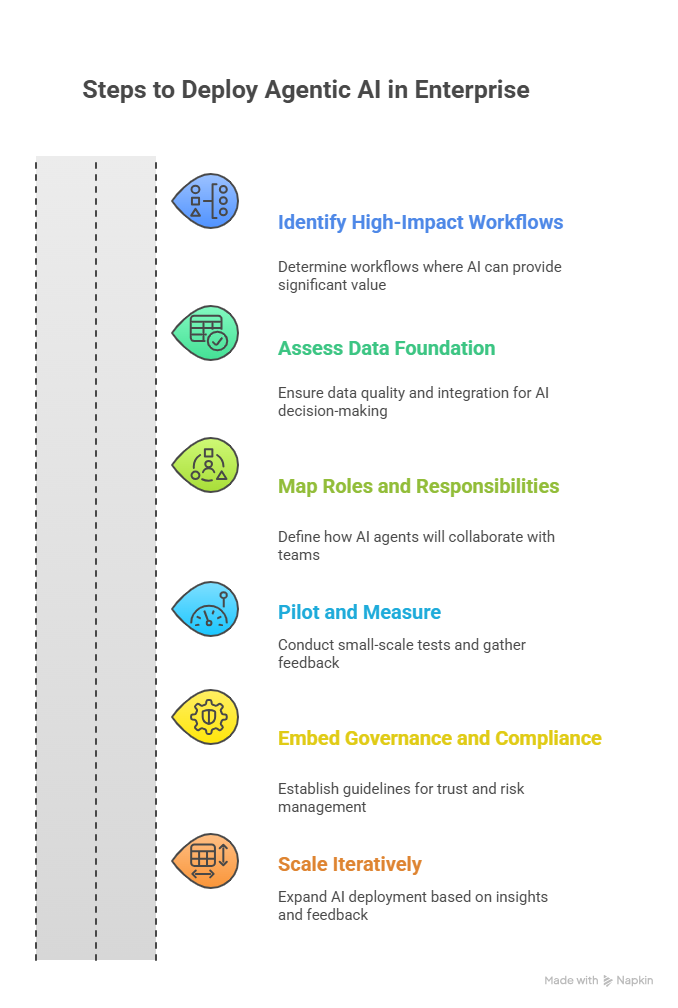
Scaling digital transformation with agentic AI begins with a structured plan. Whether you’re piloting your first autonomous agents or looking to apply agentic AI in enterprise-level transformation, it pays to follow proven steps and best practices.
Design for today. Deploy for tomorrow.
Risks and Challenges of Agentic AI
Agentic AI brings immense potential and introduces new risks and challenges that must be addressed for safe, effective adoption.
| Risk category | Description | How BlueVerse reduces risk |
| Security risk | Rogue agents can access sensitive systems | RBAC for agent permissions and a centralized policy engine to enforce strict operational guardrails on actions and data access |
| Black box risk | Agents act without explanation | Immutable audit logs provide a complete execution trace, while our Explainability API delivers a step-by-step reasoning trail for every significant decision |
| Compliance risk | Regional regulations may be breached | The centralized policy engine allows for configuring region-specific rule sets (e.g., GDPR). Real-time compliance flags halt actions that would violate a policy, pending human review |
| Human readiness | Resistance from teams | A human-on-the-loop design with clear escalation paths and approval gates in tools like Slack/Teams ensures humans remain in control. The Foundry’s low-code interface also empowers business users to co-create solutions, increasing adoption |
| Data Quality & drift | Inaccurate or outdated data leads to flawed agent actions | The UDF ingests and correlates data in real-time, ensuring agents always act on a fresh, consistent world-model. Input moderation policies validate data quality before it’s used in a decision |
💡You may wonder about the risk in GenAI vs agentic AI
While GenAI brings concerns around hallucination, black-box logic, and automation risk, agentic AI addresses these through layered safeguards, human-in-the-loop controls, and real-time transparency. These measures help enterprises innovate confidently, with trust at every step.
Ready to Unlock What’s Next with Agentic AI?
Agentic AI is a catalyst for real, enterprise-wide transformation. The future belongs to those who combine the power of autonomous intelligence with human expertise and trust.
Explore how BlueVerse Foundry and our expert team can help you move from vision to value: securely, efficiently, and at your own pace.
References
1Capitalize on the AI Agent Opportunity, Daniel Sun, Gartner, February 27, 2025: https://www.gartner.com/en/articles/ai-agents
