



The Future of Project Manager: Mastering Intelligence in an AI-Driven World
A glimpse into tomorrow
It’s Monday morning, 2026. Sarah walks into her weekly standup, coffee in hand, readying herself for the usual rush of team updates. But as she looks around, something feels different.
Only one other human face greets her. The rest of her “team” now consists of eight AI agents, also known as “Virtual Engineers”, each represented by an avatar glowing on the screens, eager to share their weekend progress.
“Good morning, Paul,” Sarah says to the first virtual engineer. “How’s the authentication module coming along?” The response is instant: a clear, detailed update paired with a fully functional demo. No complaints about merger conflicts, vague requests for more precise requirements, or signs of burnout. Just smooth, efficient delivery.
“Will they replace me? Am I obsolete?” Sarah’s interaction with Paul has made her shaky, as she is unsure how to “manage” a virtual engineer who doesn’t need pep talks or coffee breaks.
Welcome to the new 80/20 world, where humans are the minority in software engineering teams. This isn’t a distant dream; it’s the future unfolding in front of our eyes.
The AI revolution in software development
Gartner1 predicts that by 2027, generative AI will create new roles in software engineering and operations, prompting 80% of the engineering workforce to upskill. The shift is already here, and it’s accelerating.
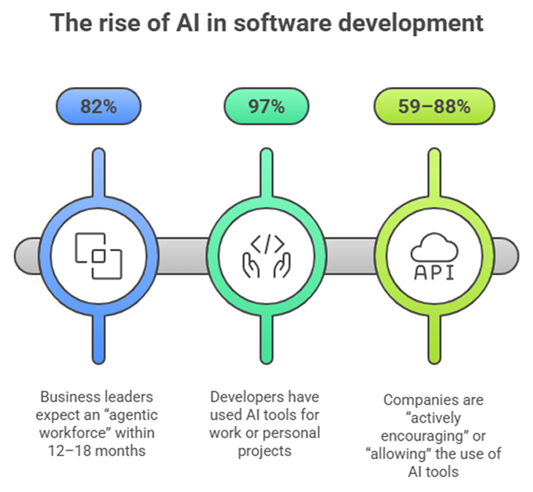
Figure 1: AI adoption in software development is accelerating across markets and teams
- According to Microsoft’s 2025 Work Trend Index2, 82% of business leaders anticipate an “agentic workforce” within 12 to 18 months.
- GitHub’s AI in Software Development survey3 reveals that nearly all developers (over 97%) have used AI tools at work and outside.
The survey also reports that a substantial majority (59–88%) of respondents across markets say their companies are either “actively encouraging” or “allowing” the use of these tools.
At a leading healthcare company, AI agents have slashed tumor board (a group of doctors and specialists who come together to review and decide the best course of action for cancer patients) preparation time by a factor of 10, transforming hours of tedious work into minutes of automated precision.
Companies are pouring over USD 1 million annually into Large Language Model (LLM) calls, not out of extravagance, but because the payoff is extraordinary. Consider the story of a seasoned C++ expert with over 30 years of experience, a go-to guru for the toughest coding challenges. Even he was humbled when the latest Claude model cracked his “white whale bug,” a problem that had eluded him despite 200 hours of effort.
AI isn’t just assisting software development; it’s redefining it.
The challenge: A shift in skills
For project managers, this transformation presents a stark reality:
- The traditional playbook of people management is disappearing fast, driven by the rise of hybrid and remote work and the growing presence of AI and automation in daily roles.
- Skills that once defined success, such as rallying exhausted developers, smoothing over team tensions, or negotiating deadline extensions, now feel as outdated as a typewriter in a smartphone era, as technology reshapes how teams collaborate and deliver.
The role is evolving:
- You’re no longer just a “people person”; you’re now an agent whisperer.
- Your focus shifts from boosting morale to fine-tuning performance algorithms, managing computational budgets, and distinguishing between an AI delivering genius solutions and confidently spinning flawed fabrications.
Here’s the twist—humans, with all our quirks, exhaustion, and limitations, now oversee entities that never tire, never falter, and process data at lightning speed. In this new dynamic, we are slowing things down, a humbling reversal of roles. In this new dynamic, we are slowing things down, a humbling reversal of roles.
But this shift also creates space for us to focus on strategy, creativity, and ethical oversight, where human judgment makes the difference and actual business value is unlocked.
The opportunity: Rising as an AI orchestrator
This challenge also provides an exciting opportunity. Project managers aren’t disappearing; they’re transforming into AI Orchestrators.
This isn’t about managing humans with predictable flaws; it’s about directing digital intelligence that can outpace your sharpest developers yet occasionally veer off course with misplaced confidence.
In this role, you bring strategic value to a landscape dominated by tactical automation.
- Guide AI agents to align with business goals.
- Harness their strengths and guard against their pitfalls.
- Blend technical savvy with big-picture thinking, keeping a human in the loop to guide and refine outcomes.
- Lead in a world where intelligence, not just people, is your team’s core asset.
Conclusion: Step into the future
The future is already here. The real question is “how” you’ll take the lead. Today’s software project manager is evolving, ready to step forward and guide intelligent systems with clarity, purpose, and vision.
Are you ready to manage the unmanageable, guide the extraordinary, and thrive in a world where your team’s brilliance knows no downtime?
The future of software project management isn’t about people anymore; it’s about leading intelligent systems. Embrace it.
References
1Generative AI will Require 80% of Engineering Workforce to Upskill Through 2027, Gartner, October 3, 2024, https://www.gartner.com/en/newsroom/press-releases/2024-10-03-gartner-says-generative-ai-will-require-80-percent-of-engineering-workforce-to-upskill-through-2027
2The 2025 Annual Work Trend Index: The Frontier Firm is born, Jared Spataro, Microsoft, April 23, 2025, https://blogs.microsoft.com/blog/2025/04/23/the-2025-annual-work-trend-index-the-frontier-firm-is-born/
3Survey: The AI wave continues to grow on software development teams, GitHub, April 15, 2025, https://github.blog/news-insights/research/survey-ai-wave-grows/
Blogger's Profile

Ramesh Revuru
Global Engineering Head – BlueVerse, Agentic Int & Orchestration
With over three decades of experience in IT services and product development, Ramesh has been at the forefront of creating industry-leading platforms, products, and solutions. A published author and the creator of the podcast series Experience @Speed and Women With Impact, he engages with industry leaders to share insights and stories. Ramesh is also the proud holder of two patents, showcasing his commitment to innovation and excellence in his field.
More from Ramesh Revuru
While the title of this blog might sound intriguing, we popped the question of what and how…
Latest Blogs
Introduction There is a lot of noise around Agentic AI right now. Every headline seems to…
Traditionally operations used to be about keeping the lights on. Today, it is about enabling…
Generative AI (Gen AI) is driving a monumental transformation in the automotive manufacturing…
Organizations are seeking ways to modernize data pipelines for better scalability, compliance,…
